

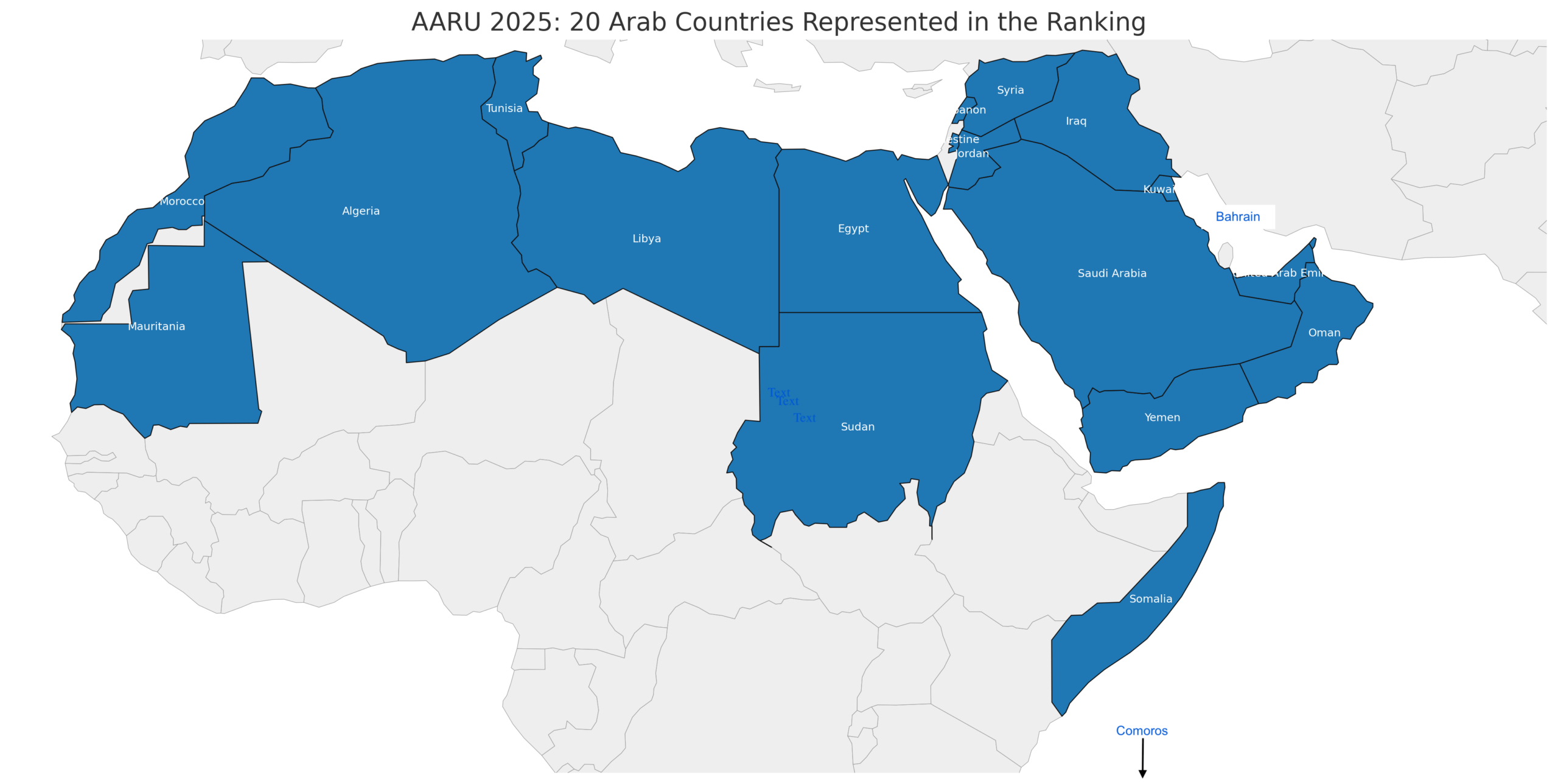
Explore AARU 2025 results covering Arab university rankings, country participation, research performance, and higher education trends across the Arab world.
The Arab Ranking for Universities (AARU), developed by the Arab Ranking for Universities Council, established in collaboration with the General Secretariat of the League of Arab States, the Association of Arab Universities, the Federation of Arab Scientific Research Councils (FASRC), and the Arab League Educational, Cultural and Scientific Organization (ALECSO), has established itself as a key regional benchmark for evaluating higher education performance across the Arab world. The ranking framework assesses universities using a balanced methodology built on four main pillars: Education and Learning (30%), Scientific Research (40%), Creativity and Innovation (15%), and International and Local Collaboration and Community Engagement (15). Together, these dimensions has dual purpose to capture academic strength and societal impact.
The 2025 edition of AARU reflects the continued expansion of the ranking in both scale and competitiveness. A total of 236 universities were ranked this year, representing 20 Arab countries, which increased from 115 universities in 2023, marking a steady increase in institutional participation compared to earlier editions. This growth highlights rising engagement with regional benchmarking and a broader commitment among Arab universities to international visibility and performance measurement.
Participation levels vary significantly by country. Iraq and Egypt lead in terms of volume, with 63 and 54 ranked universities, respectively, followed by Libya (20), Jordan (18), Saudi Arabia (14), Yemen (14), and the United Arab Emirates (8). High participation increases internal national competition, often making it more challenging for institutions to stand out domestically while also enriching the overall depth of the regional ranking.
At the top of the AARU 2025 table, leading universities continue to demonstrate balanced strength across core academic and research functions. The top ten institutions are dominated by universities from Saudi Arabia, the UAE, Egypt, Jordan, Oman, and Tunisia. A consistent pattern emerges among these top performers: strong results in scientific research and education, complemented by measurable outputs in innovation and collaboration, which together drive sustained ranking success.
Country-level performance can be viewed through two complementary lenses: quantity and quality. While some countries lead by the sheer number of ranked institutions, others stand out through average performance scores. Among countries with at least three ranked universities, the United Arab Emirates records the highest average total score, followed by Saudi Arabia, Tunisia, and Jordan. These results often reflect long-term system-level investment in research infrastructure, international partnerships, and innovation ecosystems rather than individual institutional efforts alone.
Indicator-wise analysis confirms the dominant influence of scientific research, which carries the highest weight in the AARU methodology. Across the region, research output, citation impact, and quality indicators are the primary drivers of total scores. Education and learning outcomes form the second strongest pillar, while creativity, innovation, and collaboration indicators increasingly act as differentiators among institutions with similar academic profiles.
Within this broader regional context, Gulf University (GU), is the only university represent Kingdom of Bahrain, which represent top 31% of Arab institutions. This strong performance highlights Gulf University’s rising academic reputation, improved research output, expanding innovation ecosystem, and sustained commitment to impactful community and regional engagement. This profile aligns with patterns seen across many mid-ranked universities in the Arab region, where research foundations are established and the next phase of advancement depends on scaling innovation outputs, industry engagement, and international mobility.
Overall, the AARU 2025 results portray a region characterized by expanding participation, intensifying competition, and increasing differentiation. Universities that successfully integrate strong research performance with innovation, international collaboration, and community engagement are gaining a clear strategic advantage. As more institutions enter the ranking and methodologies continue to mature, AARU is steadily shaping a more data-driven and performance-oriented Arab higher education landscape.
Dr. Tanvir Mahmoud Hussein
Head-Accreditation & Ranking,
Gulf University, Bahrain


 EN
EN  AR
AR