
High-Impact IoT Cybersecurity Research from Gulf University Published in Scientific Reports
Every time you tap your phone, monitor a patient’s vitals, or interact with smart infrastructure, encryption is running silently in the background, making all of it possible. And right now, that encryption is under increasing pressure.
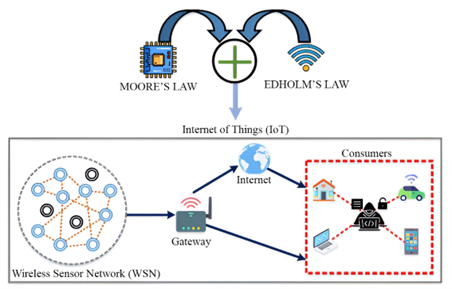
The number of devices connected to the internet is growing faster than anyone predicted. Smart cities, industrial sensors, healthcare equipment, financial terminals, billions of them, all sending and receiving sensitive data, all relying on hardware that was often not designed with today’s security threats in mind.
The question researchers and engineers are working urgently to answer is this: how do you make encryption fast enough, efficient enough, and secure enough to protect all of it?
That is exactly the problem a research team, including faculty from Gulf University’s College of Engineering, has just published a significant answer to. The study was published in Scientific Reports, one of the most prestigious Scopus journals in the world, and the third most-cited scientific journal globally. This represents a significant academic achievement.
The Problem with Securing Billions of Connected Devices
When someone connects a smart device to their home network or walks through a sensor-equipped building, most people don’t even notice it. However, every one of those devices is a potential entry point for an attacker.
These IoT devices are everywhere now. They include:
- Smart city infrastructure like traffic management systems and public utilities
- Healthcare equipment including patient monitors, insulin pumps, and diagnostic tools
- Industrial control systems managing power grids and manufacturing lines
- Financial terminals processing transactions in real time
- Consumer devices from smart speakers to connected vehicles
The challenge is that many of these devices have very limited processing power. These devices are compact, they run on minimal energy, and they cannot support computational overhead.
So, when you try to apply traditional encryption to them, you run into a wall. The encryption is either too slow, too power-hungry, or too vulnerable to the kinds of attacks that specifically target hardware implementations. This gap highlights the need for more efficient cryptographic solutions—an area directly addressed by this research.
Technical Overview of the Research
The paper is titled “Low Latency FPGA Implementation of Twisted Edwards Curve Cryptography Hardware Accelerator over Prime Field.” The paper title can be simplified as follows:
FPGA stands for Field-Programmable Gate Array is a configurable hardware platform capable of performing specialized tasks with significantly higher efficiency than general-purpose processors.
Elliptic Curve Cryptography (ECC) is a method of encryption that provides very strong security using relatively small key sizes. That makes it particularly well-suited for devices with limited resources. It is already used in everything from secure web browsing to digital signatures.
The Twisted Edwards Curve is a specific mathematical variant within the ECC family. It has some important advantages:
- Faster mathematical operations than conventional elliptic curves
- A unified addition formula that handles multiple operations in a single step
- Better built-in resistance to a class of attacks called side-channel attacks, which exploit information leaked during the physical operation of a chip
What the research team did was design a new hardware architecture that implements this cryptography on an FPGA with significantly lower latency and higher throughput than existing approaches. In practical terms, the chip they designed completes a full point multiplication, the core operation of ECC, in just 1.4 milliseconds. The performance is highly competitive within the field. And crucially, it achieves this speed without sacrificing security.
Practical Implications for IoT Security
Why does any of this matter to me?
The security of almost every connected system you interact with depends, at some level, on encryption hardware working quickly and reliably. When that hardware is slow or inefficient, one of two things happens:
- The system becomes a bottleneck, slowing down operations that depend on it
- Developers cut corners on security to compensate for the speed limitations
Neither of those outcomes is acceptable in critical infrastructure. Not in hospitals. Not in power grids. Not in financial systems. Not in the smart city networks that Bahrain and the wider GCC are actively building as part of their national development agendas.
The research addresses this directly. By developing a hardware architecture that is both faster and more secure, the team is contributing to a body of work that makes it more practical to deploy strong encryption across exactly the kinds of resource-constrained devices that power modern IoT systems.
The comparative results speak for themselves. Against existing designs in the field:
- Lower latency — the proposed architecture requires just 164,730 clock cycles for point multiplication, significantly fewer than most comparable designs
- Higher throughput — achieving 183.38 kbps, outperforming the majority of previously published approaches
- Better area efficiency — using only 4% of available slices on the Xilinx Virtex-5 FPGA platform
- Built-in side-channel attack resistance — through the unified point operation design, which makes it much harder for attackers to extract secret keys by monitoring the chip’s physical behaviour
In short, it is faster, leaner, and more secure than what came before. For high-speed wireless communication networks and IoT applications, that combination is exactly what the field needs.
Gulf University’s Role in This Research
The paper was produced by an international research team spanning institutions across Bangladesh, Malaysia, the United Kingdom, and Bahrain.
Gulf University’s contribution came through Dr. Walid El Fezzani, from the Electrical and Electronic Engineering Department in the College of Engineering, who served as one of the co-authors and contributed to the data analysis component of the research.
This type of collaboration reflects the global nature of contemporary engineering research. Gulf University, being part of that team, is a reflection of its growing presence in international research networks and its faculty’s active engagement with the global engineering and technology research community.
What This Tells You About Gulf University’s Research Direction
Gulf University has been deliberate about building a research culture that connects to real-world problems. This paper is a concrete example of that direction in action.
The research sits at the intersection of several areas the university takes seriously:
- Digital transformation — Encryption hardware is the invisible backbone of the digital economy. Without it, nothing connected is safe
- Innovation and applied research — This was not a theoretical exercise. The team built something, benchmarked it, and put the results in front of global peer reviewers
- International collaboration — Gulf University faculty working alongside researchers from Bangladesh, Malaysia, and the UK, contributing on equal terms
- Bahrain Vision 2030 — Smart cities, digital infrastructure, connected services. All of it needs exactly what this research improves
Publication in Scientific Reports: A Significant Academic Milestone
This paper did not happen overnight. And getting it into Scientific Reports, one of the most recognised Scopus journals globally, is not something that falls into your lap.
Scientific Reports is published by Nature Portfolio and is one of the most widely recognised Scopus journals in the world today. It is also indexed in Web of Science, PubMed, and Google Scholar alongside Scopus. Moreover, it receives nearly three million visitors every month from researchers around the world. Getting research published there is not routine.
Scientific Reports does not publish incremental work. The team developed a genuinely new hardware architecture and proved it outperformed existing designs. Also, it requires work that passes rigorous peer review and meets the journal’s standards for scientific validity.
A University That Does More Than Teach
There is a version of a university that stays inside its own walls. It teaches, it assesses, it graduates students, and its relationship with the wider world of knowledge is mostly passive. Gulf University is definitely not that type of institution.
Publishing research in Scientific Reports is not something that happens by accident or by simply submitting a paper and hoping for the best. The journal receives submissions from researchers all over the world and accepts work that holds up to serious peer scrutiny. Gulf University faculty went through that process and came out the other side with their name on a published paper.
This publication demonstrates Gulf University’s growing contribution to high-impact, globally relevant research in cybersecurity and digital infrastructure.
For students considering Gulf University, that is a practical thing to know. The faculty teaching you are not just reading the literature in their subject areas. They are contributing to it.
Keywords: IoT cybersecurity, encryption hardware, FPGA, elliptic curve cryptography, Gulf University research, Scientific Reports, Nature Portfolio, Scopus Journal


Last Updated: 04 Aug 2026