March 30, 2026
The Smart City Revolution: Building a Sustainable Future Through Technology and Urban Innovation
Assoc. Prof. Dr. Mohammed N. Abdulrazaq Alshekhly

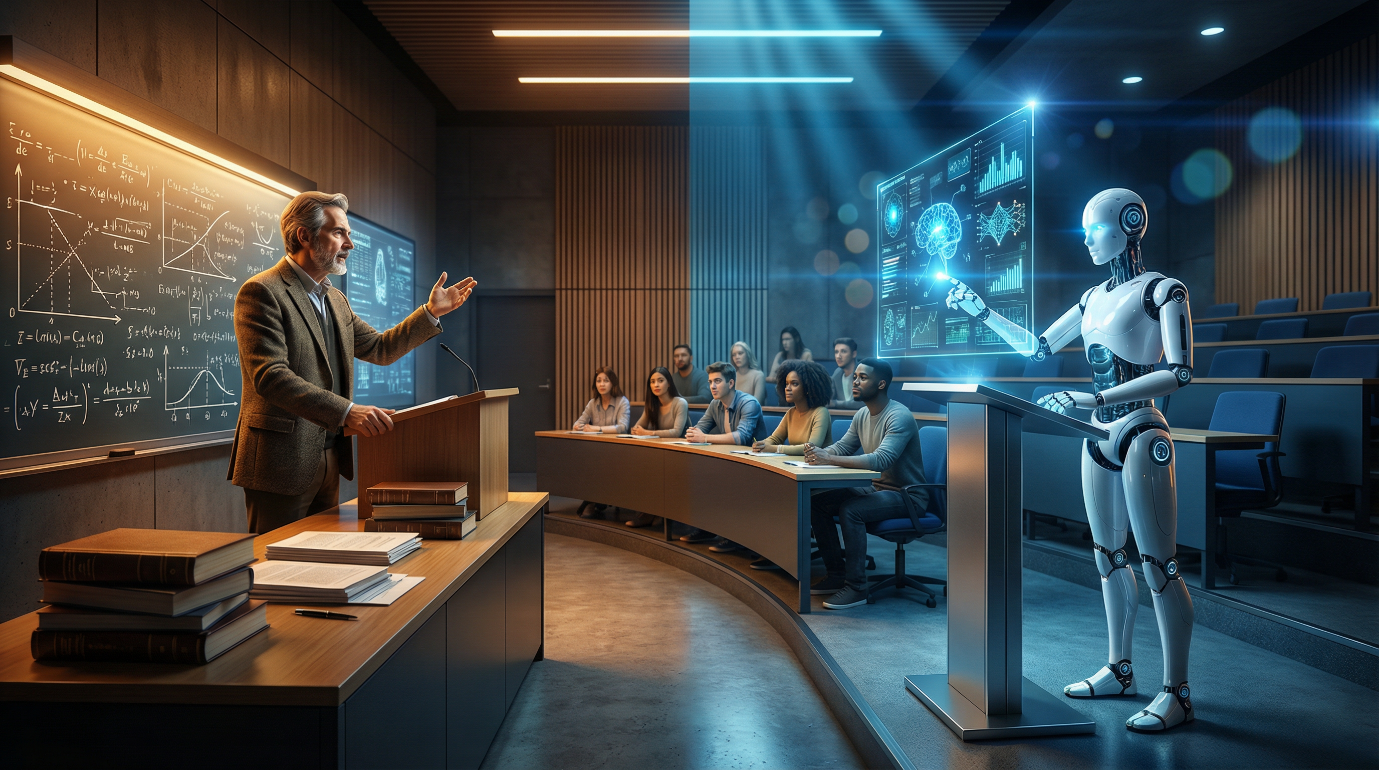
Technology visionaries have recently made bold predictions suggesting that within a decade, artificial intelligence will replace many traditional professions, including teaching. This article examines whether AI will truly replace professors or redefine their role in higher education.
Technology visionaries have recently made bold predictions that send ripples through the academic community, suggesting that within a decade, artificial intelligence will replace many traditional professions, including teaching. As generative artificial intelligence continues to evolve at an unprecedented pace, this provocative idea forces higher education institutions to confront an existential question: If an algorithm can generate a comprehensive syllabus, grade essays in seconds, and tutor students with infinite patience, what is the future of the human professor?
While the rapid integration of AI in universities has sparked understandable anxiety about job displacement, a closer examination of pedagogical science suggests a more nuanced reality. Artificial intelligence is not poised to replace the professor entirely, but it is undeniably forcing a profound redefinition of what it means to be an educator in the 21st century.
The vulnerability of academic roles to AI automation is not evenly distributed. Analyses of large language models’ impact on higher education reveal that the most vulnerable positions are those defined by structured, repetitive, and rules-based workflows. In the context of faculty work, this means that roles heavily reliant on generic lecture delivery, low-authenticity assessment, and standardized feedback are highly exposed to automation.
The efficacy of AI in these domains is no longer theoretical. Recent empirical studies have demonstrated that students using an AI tutor can learn significantly more in less time compared to those engaged in traditional in-class active learning. When a machine can deliver content and assess basic comprehension more efficiently than a human, the traditional “sage on the stage” model of teaching becomes obsolete.
The encroachment of AI into instructional design has not been met without resistance. Many educators view the automation of teaching tasks not as a convenience, but as a devaluation of human labor. There is a growing concern regarding the impending “bot-ification” of the professoriate—a fear that when faculty surrender their intellectual property to AI-driven courseware, they risk making themselves interchangeable and ultimately unnecessary.
These concerns are compounded by deep skepticism regarding AI’s impact on student development. National surveys of university faculty reveal widespread apprehension that generative AI will increase students’ overreliance on automated tools, diminish critical thinking skills, decrease attention spans, and negatively affect the integrity and value of academic degrees. These statistics highlight a critical tension: while AI excels at generating output, educators overwhelmingly fear that it degrades the cognitive processes essential to deep learning.
If routine instructional tasks are ceded to algorithms, what remains for the human professor? The answer lies in the capabilities that machines fundamentally lack. Leading research frameworks have identified five uniquely human capability groups that AI struggles to replicate, essential to the future of the academic profession:
The ability to understand student struggles, provide emotional support, and foster a sense of belonging.
Building professional relationships, mentoring students, and integrating them into academic communities.
Navigating moral dilemmas, evaluating complex qualitative research, and maintaining academic integrity.
Designing innovative research paradigms and inspiring intellectual curiosity.
Guiding students through uncertainty and motivating them toward future goals.
A “hard” skill, like solving a complex equation, is comparatively easy to program into a machine. It is much harder—perhaps impossible—to program critical human capabilities such as hope, empathy, and creativity.
Rather than facing outright replacement, the professoriate is entering an era of augmentation. In this new paradigm, the value of an educator is no longer derived from the mere transmission of information, but from the application of human judgment to agentic output. This shift can be encapsulated in a modern workforce formula: professional value is a function of human judgment applied to machine output. If human judgment is zero, the value of the work is zero, regardless of the AI’s efficiency.
Faculty whose work centers on coaching, seminar leadership, studio critique, clinical supervision, and community-engaged learning will become increasingly valuable. The professor of the future will act less as an information dispenser and more as an “AI Orchestrator”—curating algorithmic tools to handle routine tasks while dedicating their human bandwidth to the capabilities that drive true intellectual and personal transformation.
Will AI replace the professor? The answer is both yes and no. The version of the professor who merely recites textbook chapters and grades multiple-choice exams is likely facing extinction. However, the professor who acts as a mentor, a moral guide, and an intellectual provocateur has never been more essential. As artificial intelligence forces higher education to strip away the mechanical aspects of teaching, what remains is the profound, irreplaceable core of human connection. Perhaps the most accurate prediction for the future of higher education is not one of human obsolescence, but of technological adaptation:
“AI will not replace professors, but professors who use AI will replace those who do not.”
The future of the university relies not on competing with algorithms, but on mastering them while elevating the humanity that machines can never possess.
Assoc. Prof. Dr. Mohammed N. Abdulrazaq Alshekhly
Chair of University Research Council, Gulf University, Bahrain
Last Updated: 09 Apr 2026