November 24, 2024
Post-Interactivity: Media and the Technological Revolution
Dr. Abdulla Altaher

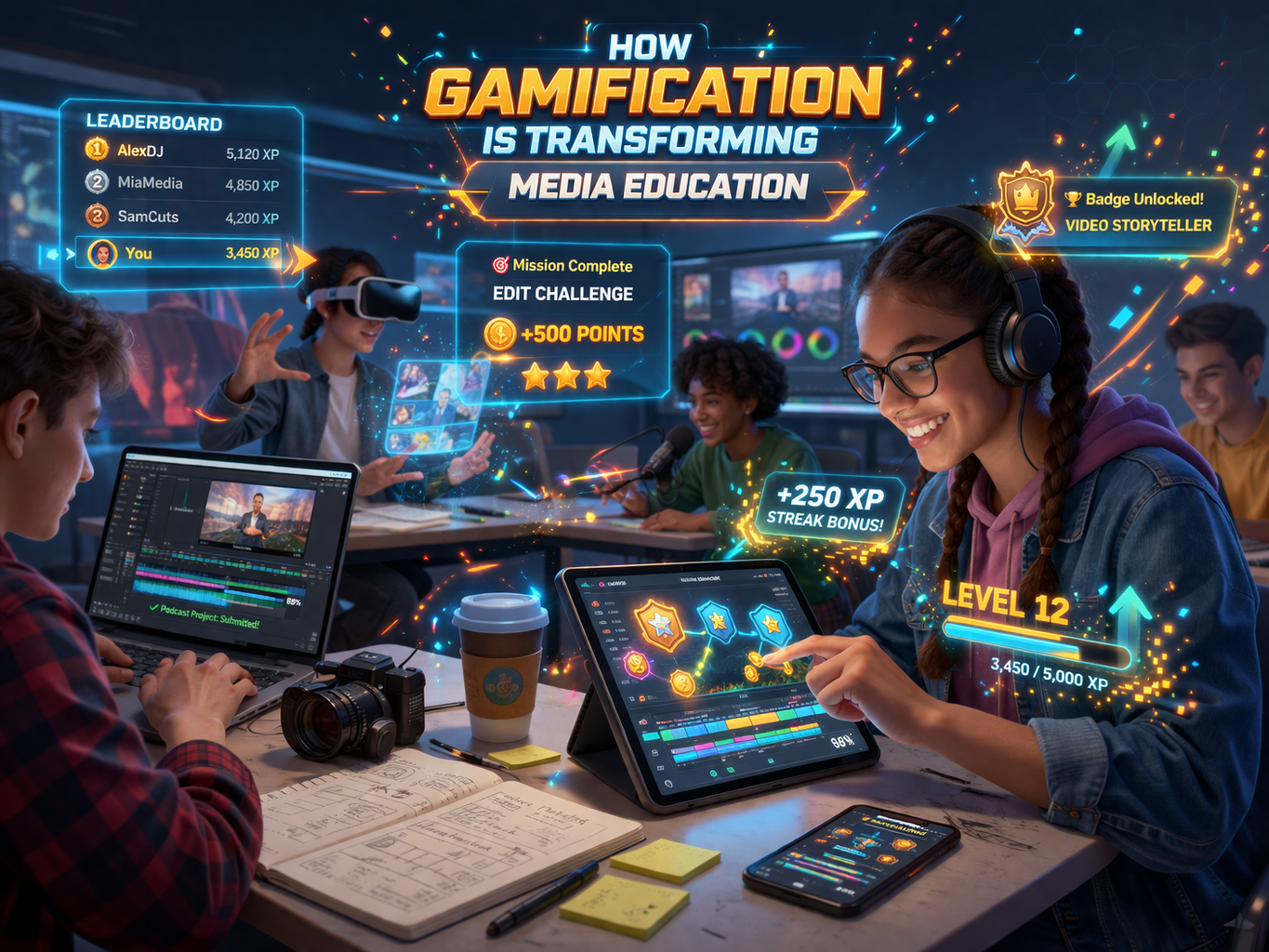
From Passive Learners to Media Innovators: How Gamification Is Revolutionizing Media Education. Explore how gamification in media education boosts engagement, builds real-world skills, and transforms students into active creators.
From Passive Viewers to Active Creators: How Gamification is Reshaping Media Classrooms. Media education is undergoing a dynamic transformation, driven by the principles of game-based learning.
Media education has traditionally balanced theoretical understanding with practical production skills. Students learn communication theories, analyze media texts, and develop technical competencies in areas like video editing and journalism. Gamification—the application of game-design elements in non-game contexts—now introduces powerful pedagogical tools that increase engagement, deepen learning, and better prepare students for the interactive media landscape they will enter as professionals.
The challenge of sustaining student motivation in theory-heavy courses finds innovative solutions through gamification. Points, badges, and leaderboards transform routine assignments into meaningful challenges. For example, a media ethics course might award “integrity points” for correctly identifying ethical dilemmas in case studies, with students advancing through levels as they demonstrate mastery. This approach encourages continuous engagement and creates visible progress markers that traditional grading often lacks.
Beyond engagement mechanics, gamification creates safe spaces for experiential learning. Media production inherently involves high-stakes decisions—budget allocations, ethical choices, deadline pressures—that students rarely experience before entering the workforce. Simulation-based learning allows students to manage virtual newsrooms, respond to simulated PR crises, or allocate production budgets within realistic constraints. These experiences build decision-making confidence while allowing mistakes without real-world consequences.
Media production is fundamentally collaborative, yet traditional coursework often emphasizes individual achievement. Gamified structures can foster teamwork through “quests” requiring coordinated effort. A course in digital media production might assign groups to complete a “campaign challenge,” where teams earn points for creativity, technical execution, and audience engagement metrics. This approach mirrors agency environments where collaborative skills determine success.
Game design emphasizes rapid feedback—players know immediately whether their actions succeeded. Gamified learning applies this principle through instant assessment mechanisms. A journalism student submitting a headline might receive immediate AI-generated feedback on clarity and SEO optimization before instructor review. These loops encourage experimentation and iteration, moving students beyond fear of failure toward a growth mindset essential for creative fields.
Transform routine assignments into meaningful challenges with visible progress markers that encourage continuous engagement.
Safe spaces for experiential learning where students manage virtual newsrooms, respond to PR crises, and allocate budgets.
Team-based challenges that mirror agency environments where creativity, execution, and audience engagement are rewarded.
Instant assessment mechanisms that encourage experimentation, iteration, and a growth mindset essential for creative fields.
The value of gamification extends beyond pedagogy. Media industries increasingly employ game-like structures in professional contexts. News organizations use engagement metrics that function like performance scores. Marketing campaigns incorporate interactive elements that reward consumer participation. Understanding gamification principles prepares students for workplaces where engagement strategies and user experience design are core competencies.
As technology evolves, gamification will integrate more deeply with emerging media forms. Virtual reality environments will enable immersive scenario training for crisis communication. Blockchain-based credentialing could transform how student achievements are recognized and shared with employers. Adaptive gamification systems will tailor challenges to individual learning paces, ensuring all students remain appropriately challenged. The future of media education lies in creating learning experiences that are as engaging, interactive, and responsive as the media environments students will help shape.
As classrooms evolve into immersive, interactive environments, the real question is no longer whether to adopt gamification, but how far we can push its potential to shape the next generation of media professionals.
As classrooms evolve into immersive, interactive environments, the real question is no longer whether to adopt gamification, but how far we can push its potential to shape the next generation of media professionals.
Dr. Naglaa Elgammal
College of Communication and Media Technologies — Gulf University
Last Updated: 09 Apr 2026