March 27, 2026
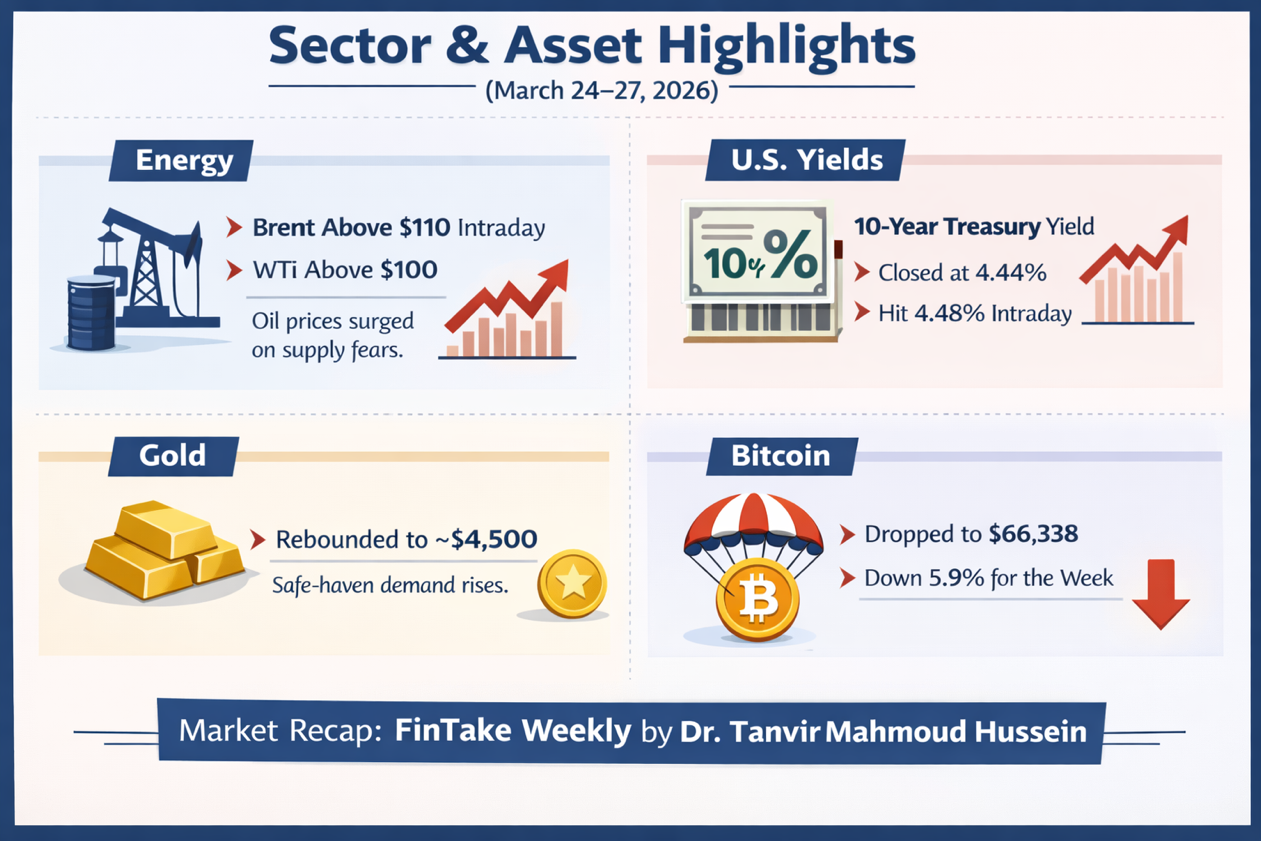
Oil Shock, Tech Slide: Markets Rattle as Risk Returns
Dr. Tanvir Hussein

A weekly stock market roundup from Gulf University covering global, GCC, and Bahrain markets, highlighting key trends, oil price movements, geopolitical risks, and investor sentiment for the week ending April 10, 2026.
Last week was a defining moment for global financial markets. While the beginning of April was marked by intense geopolitical uncertainty, a sudden shift in sentiment mid-week sparked a relief rally that spanned from New York to Manama.
The US equity markets snapped a multi-week losing streak. Investors shook off initial recession fears and focused on a cooling of geopolitical tensions.
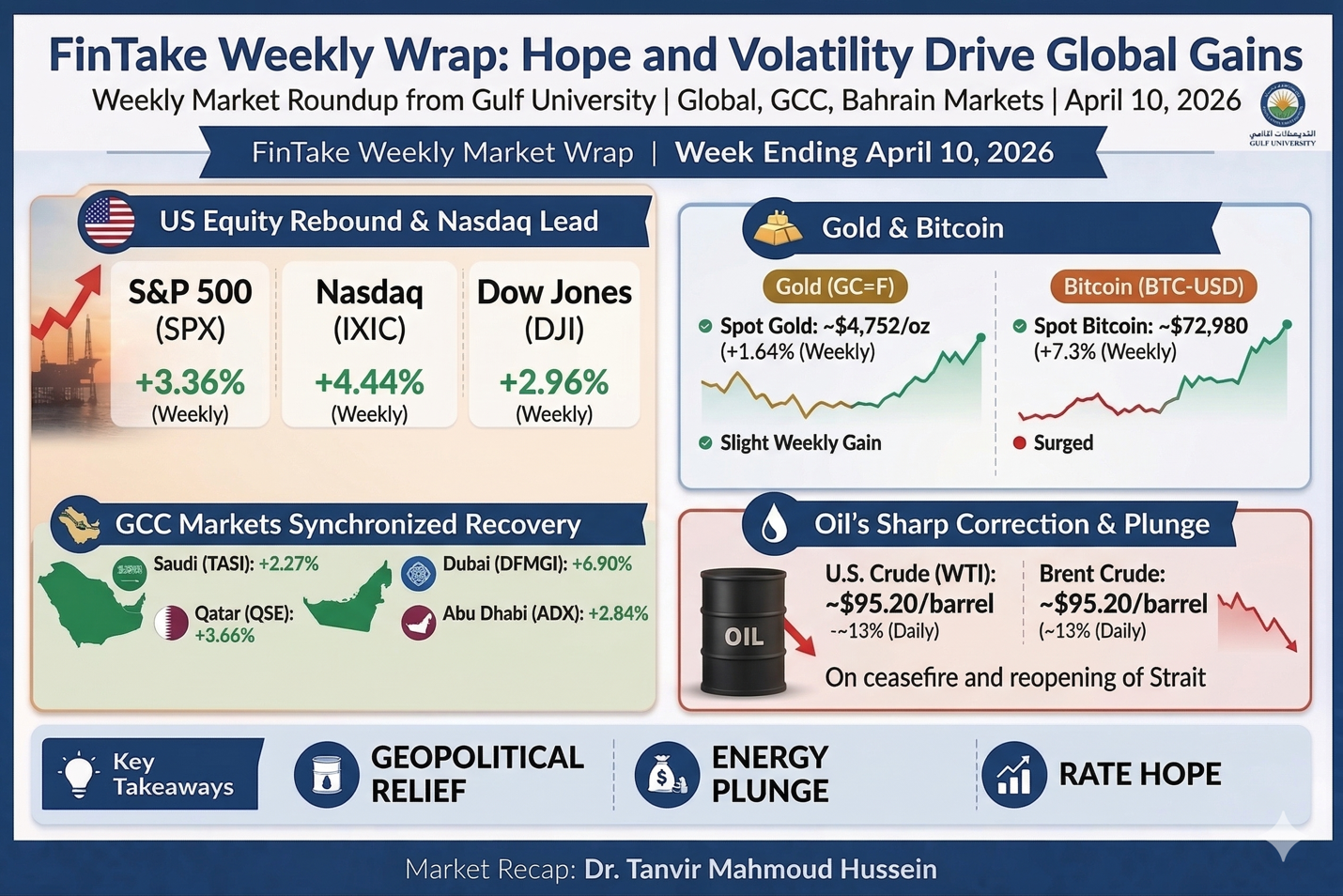
According to Yahoo Finance, the major indices saw significant gains through the week ending April 10:
The Gulf Cooperation Council markets mirrored the global optimism, particularly after news of a diplomatic breakthrough involving the reopening of the Strait of Hormuz.
Saudi Arabia remained one of the steadier markets in the region. Trading Economics showed the Tadawul All Share Index at 11,339 on April 9, little changed on the day, and up 2.27%. Investors were encouraged by strong trading volumes totaling SAR 8.4 billion.
Qatar’s performance at Stock market was impressive. According to Qatar News Agency, the Qatar Stock Exchange index closed on April 9 gained 3.66%, crossing the 11,200 mark. That reflected confidence returned.
The UAE market also surged, Dubai’s DFMGI led the region with a massive 6.90% growth, fueled by double-digit gains in blue-chip stocks like Emaar Properties and Emirates NBD. Abu Dhabi’s ADX also rose by 2.84%.
Taken together, the GCC story this week was one of synchronized recovery and renewed optimism. The region surged following the diplomatic breakthrough at the Strait of Hormuz, with the UAE leading the charge, Qatar followed suit with an impressive return of investor confidence while Saudi Arabia remained the region’s steadier anchor, posting solid gains on high trading volumes. Overall, the markets moved from a state of cautious tension to a broad-based rally, as fears of escalation were replaced by the positive momentum of reopened trade routes and strong blue-chip performance.
The Bahrain Bourse maintained a more conservative but positive trajectory. The Bahrain All Share Index edged up by 0.29% during the week, closing at 1,893.79.
Much of the local focus remained on corporate governance and annual general meetings, with major players like BBK and NBB releasing material disclosures that kept investor confidence stable despite the regional volatility. While KFH was a notable gainer, rising to 2.680. The Bourse recently listed 3-month Treasury Bills (Issue 2115) and 6-month Islamic Sukuk (Issue 6IM8) to bolster liquidity.
The Bahrain Bourse remained steady and cautious, moving upward slightly while avoiding the sharp ups and downs seen in other markets. Investor confidence stayed firm as major local banks shared important updates during their annual meetings. Gains from key players like KFH helped support the market, while the government’s introduction of new short-term investment tools helped keep money flowing smoothly through the system. Overall, it was a week of quiet stability focused on local corporate news rather than regional drama.
Oil prices plunge with the announcement of a ceasefire.
For the trading week ending Friday, April 10, 2026, the performance of major commodities was defined by a significant rotation in risk sentiment following the announcement of a conditional two-week ceasefire between the U.S. and Iran.
Brent crude oil futures experienced a dramatic plunge, falling nearly 13% in a single session to settle at $95.20 per barrel as the “war premium” rapidly evaporated.
Gold prices also saw a cooling effect as the immediate flight-to-safety trade receded; the metal faced renewed selling pressure, closing at $4,751.68 per ounce, though it maintained a slight weekly gain of 1.64%.
In contrast, Bitcoin surged as risk appetite returned to the markets, rising 7.3% over the week to trade at approximately $72,979, briefly testing its historical resistance levels near $73,400.
Three forces shaped the week.
The first was geopolitical relief. A surprise two-week ceasefire and the partial reopening of the Strait of Hormuz triggered a massive “risk-on” rally, causing global equities to surge as the immediate threat of regional disruption faded.
The second was plunging energy prices. The sudden evaporation of the “war premium” caused Brent crude to plummet 13%, providing a boost to global transportation and tech stocks while putting pressure on GCC energy heavyweights.
The third was diverging inflation signals. While headline inflation spiked due to past energy costs, a cooler “core” CPI reading renewed hope for future rate cuts, though record-low consumer sentiment reminded investors that the economic recovery remains fragile.
It was a week of relief-driven rebound, as geopolitical de-escalation sparked a surge in equities.
Last week taught us that market sentiment can pivot on a single headline. While the U.S. benefited from strong domestic jobs data, the GCC and Bahrain markets were more sensitive to regional security and oil price fluctuations. For the coming week, all eyes will remain on the sustainability of the current ceasefire and the next round of inflation data from the Federal Reserve.
Sources mentioned: AP news, The Guardian, Qatar News Agency, Trading Economics, Al Jazeera, Zawya/Kamco Invest, and Bahrain Bourse, Bullion rates, yahoo finance.
Market sentiment can pivot on a single headline — geopolitical de-escalation sparked a surge in equities across the globe.
Dr. Tanvir Hussein
College of Administrative and Financial Science — Gulf University
Last Updated: 10 Apr 2026
