May 4, 2026
FinTake Weekly Market Wrap: Tech Momentum Continues, Oil Stabilizes, Bahrain Holds Firm
Dr. Tanvir Mahmoud Hussein
A weekly stock market roundup from Gulf University covering global, GCC, and Bahrain markets, with a focus on index performance, commodities, earnings, policy signals, and investor sentiment.
Global equity markets extended their upward momentum during the week ending 8 May 2026, led once again by technology, semiconductors, and artificial intelligence-linked stocks.
The S&P 500 and Nasdaq Composite closed at record highs on Friday, supported by strong earnings optimism and a better-than-expected U.S. jobs report. The rally, however, remained concentrated in large-cap technology names, while broader market participation was more mixed. Reuters reported that the S&P 500 and Nasdaq recorded their sixth consecutive weekly gains, the longest winning streak since October 2024.
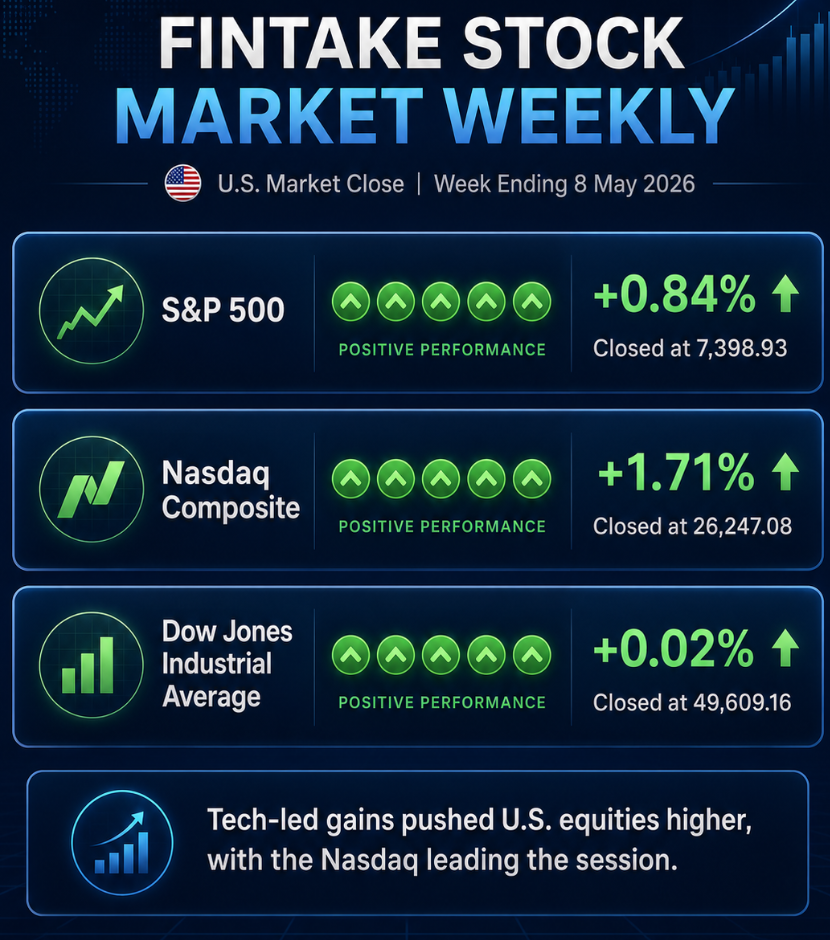
The S&P 500 climbed 0.84% to end the session at 7,398.93 points. The Nasdaq gained 1.71% to 26,247.08 points, while the Dow Jones Industrial Average rose 0.02% to 49,609.16 points.
| Index | Friday’s Close | Week’s Change | % Change YTD |
|---|---|---|---|
| Nasdaq Composite | 26,247.08 | +4.5% | +12.9% |
| S&P 500 | 7,398.93 | +2.3% | +8.1% |
| DJIA | 49,609.16 | +0.2% | +3.2% |
| Russell 2000 | 2,861.21 | +1.7% | +15.3% |
| S&P MidCap 400 | 3,699.83 | +1.6% | N/A |
Source: AP News, Reuters, and market data compiled by FinTake. This table is for illustrative purposes only. Past performance cannot guarantee future results.
AP reported that, for the week, the Nasdaq rose 4.5%, the S&P 500 gained 2.3%, the Dow increased 0.2%, and the Russell 2000 advanced 1.7%. The same report placed year-to-date gains at 12.9% for Nasdaq, 8.1% for S&P 500, 3.2% for Dow, and 15.3% for Russell 2000.
GCC markets showed mixed performance during the week. Oil prices remained high, offering support to regional sentiment, but investor confidence was limited by uncertainty around the U.S.–Iran conflict and the Strait of Hormuz.
Dubai and Abu Dhabi ended the week with positive weekly gains despite Friday’s weakness. Reuters reported that Dubai’s main index fell 0.5% on Friday, while Abu Dhabi declined 0.4%, but both markets still posted weekly gains of 2.4% and 0.5%, respectively.
Saudi Arabia’s TASI closed at 11,031.32 on 7 May, compared with 11,187.66 on 30 April, reflecting a weaker weekly performance. Dubai’s DFM General Index closed at 5,902.21 on 8 May, compared with 5,766.05 on 30 April, showing clear weekly improvement.
Investor sentiment across the GCC remained selective, with stronger interest in energy, banking, telecom, and infrastructure-linked names rather than a broad-based equity rally.
Bahrain delivered a positive weekly performance. According to the Bahrain Bourse weekly trading report for the week ending 7 May 2026, the Bahrain All Share Index increased from 1,911.54 to 1,941.69, a gain of 30.2 points or 1.58%.
Weekly trading activity reached approximately 28.84 million shares, with a traded value of about BD 7.88 million and 1,391 trades recorded.
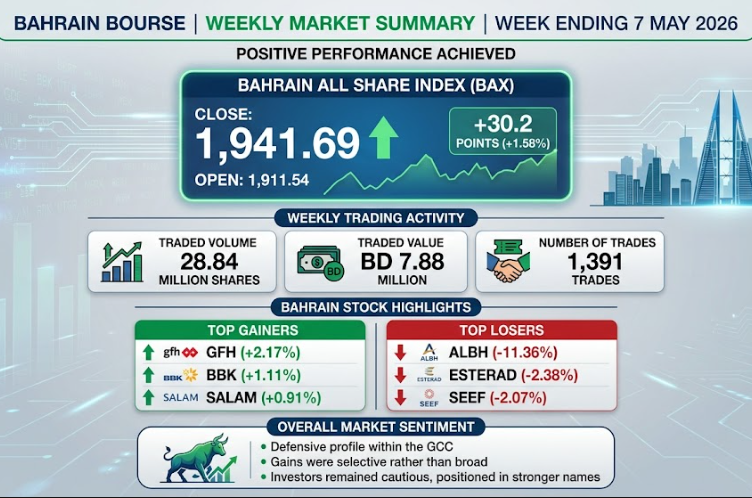
Among the highlighted securities, GFH rose 2.17%, BBK gained 1.11%, and SALAM increased 0.91%. On the downside, ALBH declined 11.36%, ESTERAD fell 2.38%, and SEEF dropped 2.07%.
Overall, Bahrain’s market continued to show a defensive profile within the GCC. Gains were selective rather than broad-based, suggesting that investors remained cautious but willing to position in stronger names.
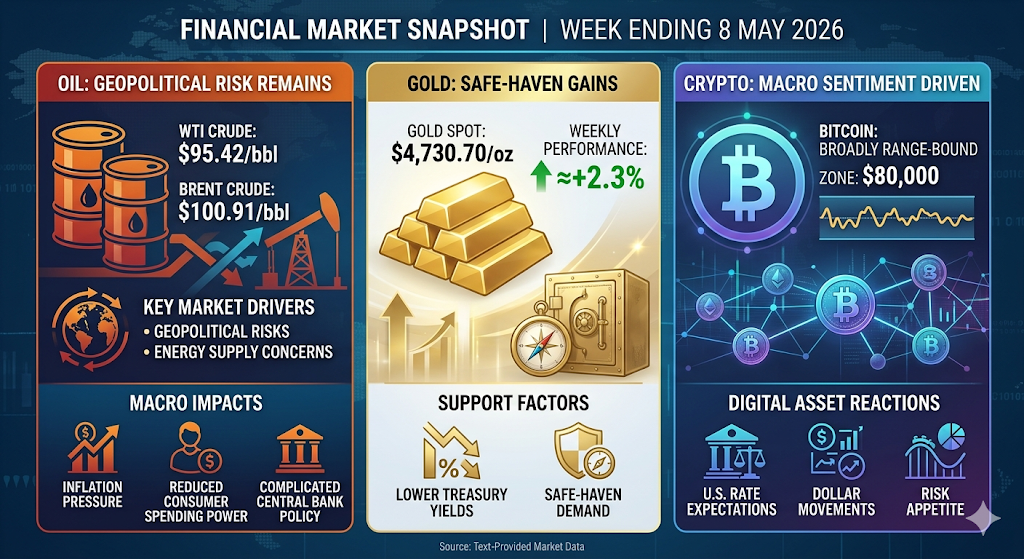
Oil prices remained elevated as geopolitical risks continued to influence energy markets. On 8 May, WTI crude settled at $95.42 per barrel, while Brent crude stood at $100.91 per barrel.
Oil remained a key macro risk for markets. Higher energy prices can increase inflationary pressures, reduce consumers’ spending power, and complicate central bank policy decisions.
Gold gained during the week, supported by lower Treasury yields and safe-haven demand. Gold settled at $4,730.70 per ounce on 8 May, with weekly performance reported at approximately +2.3%.
Bitcoin remained broadly range-bound around the $80,000 zone, with crypto sentiment driven mainly by macro conditions rather than strong independent momentum. Digital assets continued to react to U.S. rate expectations, dollar movements, and risk appetite.
The week ending 8 May 2026 reinforced a market environment led by technology strength, strong earnings, and resilient economic data. However, the rally remains dependent on a limited number of growth sectors, especially AI and semiconductors.
For GCC markets, oil continues to provide support, but geopolitical uncertainty remains a major constraint. Bahrain’s steady weekly gain highlights its defensive market character within the region, appealing to investors seeking lower volatility and stable returns.
FinTake View: Market momentum remains positive, but investors should remain selective. Quality earnings, strong balance sheets, and exposure to long-term growth themes remain important — while oil volatility and interest-rate uncertainty should not be ignored.
Disclaimer: This report is for educational and informational purposes only and does not constitute investment advice. Past performance is not indicative of future results.
Sources: AP News, Reuters, Bahrain Bourse, Bureau of Labor Statistics, Federal Reserve, Dubai Financial Market, Investing.com, Investrade, Yahoo Finance.
Dr. Tanvir Hussein
College of Administrative and Financial Science — Gulf University
Last Updated: 08 May 2026